Technique · 7 min read
Cake tin sizes, and how to convert any recipe
Tins scale by area, not width, which is why a 23 cm tin gives a flat cake from a 20 cm recipe. The table, the arithmetic, and a real recipe converted both ways.
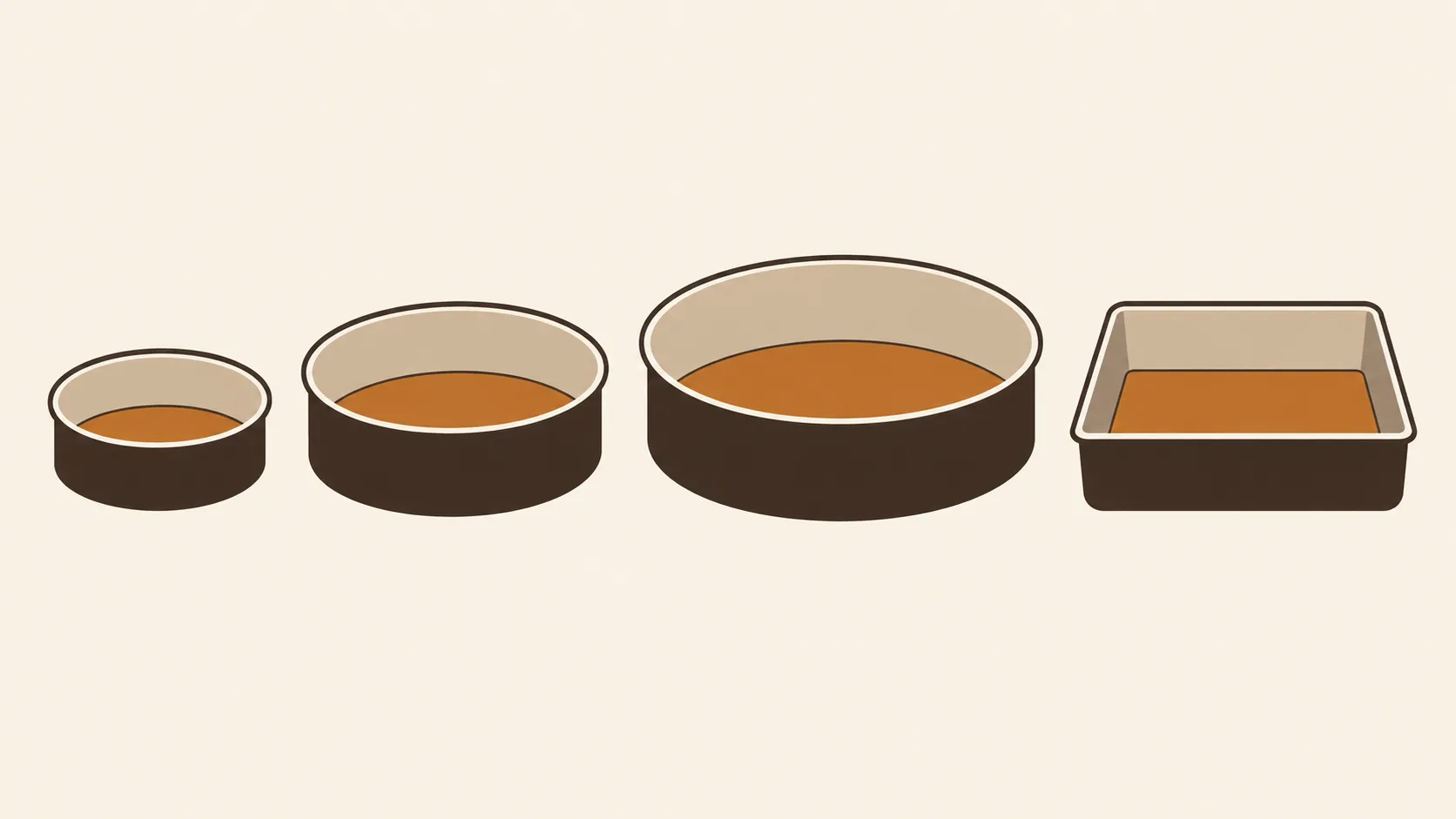
Every recipe here is written for a 20 cm round springform tin, the 8 inch tin in American recipes. Put one in a 23 cm tin, the 9 inch, and the cake comes out a third thinner and bakes faster, because tins scale by area while we think of them by width. Three centimetres sounds like a rounding error. In a tin it is a third more cake, or a third less.
A conversion has two parts. How much batter the tin wants is area. How long the cake needs is depth.
The table
The area of a round tin is π times the radius squared, and the factor between two tins is the ratio of their diameters, squared. Going from 20 to 23 cm: 23 divided by 20 is 1.15, and 1.15 squared is 1.32.
| Tin | Area | Compared with 20 cm |
|---|---|---|
| 15 cm round (6 inch) | 177 cm² | 0.56 |
| 18 cm round (7 inch) | 254 cm² | 0.81 |
| 20 cm round (8 inch) | 314 cm² | 1.00 |
| 23 cm round (9 inch) | 415 cm² | 1.32 |
| 25 cm round (10 inch) | 491 cm² | 1.56 |
| 20 cm square (8 inch) | 400 cm² | 1.27 |
| 23 cm square (9 inch) | 529 cm² | 1.68 |
A square tin of the same stated size holds about a quarter more than the round one, because it keeps the corners. King Arthur Baking’s rules of thumb come from the same arithmetic: a 9 inch round holds 27% more than an 8 inch round, and an 8 inch square and a 9 inch round can stand in for one another.
The inch factors are a little smaller than the centimetre ones, because a 9 inch tin is 22.9 cm, so if your tins are marked in inches, use 1.27 rather than 1.32 for 8 to 9. In practice, round to something you can weigh.
Two ways to convert
Scale the recipe: multiply every weight by the factor and round to the nearest 5 g, all the same way so the ratios do not drift. Then check the raising agent against the flour it now has to lift, one to one and a half level teaspoons of baking powder per 150 g, and fill the tin no more than two-thirds up, which is King Arthur’s rule as well as this site’s.
Keep the recipe and change the time: a larger tin gives a shallower cake, so start testing 10 to 15 minutes early; a smaller tin gives a deeper one, so expect 10 to 15 minutes more, and more browning on top. Both figures are King Arthur’s, for a tin one size away from the recipe’s. Further than that, a deeper cake needs the oven turned down as well as more time, or the outside is finished long before the centre, which is how cakes end up raw in the middle.
Scaling the eggs
Multipliers never land on a whole egg. Three eggs times 1.32 is 3.96; times 0.81 it is 2.43, and rounding either to the nearest egg changes the structure and the moisture at once. Weigh them instead. A large egg out of its shell is about 50 g, the figure the recipes here are built on, so three eggs are 150 g: scaled up by 1.32 that is 198 g, which is four eggs; scaled down by 0.81 it is 121 g, so beat three together in a jug and weigh out 120 g.
A real recipe, both ways
The blueberry and lemon cake here, for a 20 cm tin: 250 g plain flour, 1.5 tsp baking powder, a quarter teaspoon of bicarbonate of soda, a pinch of salt, 130 g butter, 230 g caster sugar, 3 eggs, the zest of 2 lemons, 120 g buttermilk, 50 ml lemon juice and 100 g blueberries. It serves 10 and bakes 52 to 60 minutes at 175°C, 155°C fan.
Up to 23 cm, times 1.32: 330 g flour, 2 tsp baking powder, a third of a teaspoon of bicarbonate, 170 g butter, 305 g sugar, 4 eggs, the zest of 3 lemons, 160 g buttermilk, 65 ml juice and 130 g blueberries. Serves 13.
Down to 18 cm, times 0.81: 200 g flour, 1.25 tsp baking powder, a scant quarter teaspoon of bicarbonate, 105 g butter, 185 g sugar, 120 g of beaten egg, the zest of 2 lemons, 95 g buttermilk, 40 ml juice and 80 g blueberries. Serves 8.
The depth does not move. About a litre of batter over 314 cm² is 3.2 cm deep, and 1.32 litres over 415 cm² or 810 ml over 254 cm² come to the same. So the time does not move either: 175°C, start testing at 52 minutes, in all three tins.
Loaf, muffin and bundt tins
A 900 g loaf tin, about 23 by 13 cm at the rim, has nearly the area of a 20 cm round at the top but tapers, so the same batter sits deeper. Use the full recipe, fill it no more than two-thirds, expect 10 to 15 minutes longer, and cover the top with foil when it has its colour before the centre is set.
A 12-hole muffin tin takes the full recipe at two-thirds full, 12 to 15 muffins, at the recipe’s own temperature. Start testing at 18 minutes.
Bundt tins are sold by volume. King Arthur’s figure for a 10-cup bundt is about 6 cups of batter, 1.4 litres, which is a 20 cm recipe with room to spare. Grease every crevice with melted butter and a brush, then flour it, because a non-stick coating alone is not enough on a shaped tin. Start testing at 45 minutes, and turn it out at 15 rather than the round tin’s 20, because sugar setting against the pattern sticks.
Square tins, and why the corners cook first
A 20 cm square holds 1.27 times a 20 cm round, so swapping one for the other is a scaling job: multiply by 1.27, or keep the recipe and expect a cake a fifth shallower, done 8 to 10 minutes early. Heat enters a corner from two walls at once, so the corners set well before the middle. Line the base and sides with paper rather than only greasing, test in the geometric centre, never halfway to a corner, and drop the oven 10°C on a sugary batter.
The tin itself
Springform, because these cakes are soft when warm and a ring that unclips is the only way to release one whole. The seam can leak a thin batter, so stand the tin on a baking tray. A solid tin has to be inverted, which suits a firm sponge and wrecks a fudgy one.
The metal matters as much as the mechanism. King Arthur’s notes: dark tins brown the edges hardest, light metal bakes most evenly, glass and ceramic heat slowly and brown less, and a tall-sided tin shields the top. Drop the oven 10°C in a dark tin.
What not to convert
Anything whose texture depends on its depth. A tall, fudgy chocolate cake in a wide, shallow tin becomes a brownie, and a batter that rises and cracks in a 20 cm tin will not crack in a 25 cm one, because it never gets deep enough to build pressure. If a recipe makes a point of the tin, it means the tin.
Where this comes from
- King Arthur Baking, The essential alternative baking pan sizes: pan areas in square inches, the 8 inch square and 9 inch round equivalence, the 10-cup bundt holding about 6 cups.
- King Arthur Baking, Why the size of your baking pan matters so much: half to two-thirds full, 10 to 15 minutes either way for a tin one size out, dark, light, glass and tall tins.
- The areas in the table are arithmetic, π times the radius squared, and the worked example uses the recipe as published on this site.